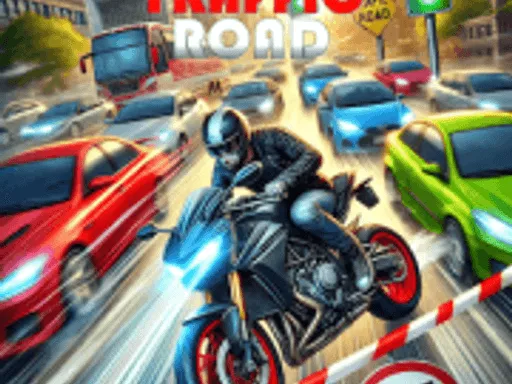
Traffic Road






Rating:
4.34
Played:
11,082
When Highway Rhythm Meets Reflex Racing
At first glance, Traffic Road looks simple: you get on a fast bike, merge into active traffic, and stay alive as long as possible. In practice, it becomes a tight rhythm game disguised as an arcade racer. Every lane change is a timing decision, every overtake is a small risk-reward calculation, and every second at higher speed increases both your score potential and your chance of ending the run. The game is built around momentum. You are reading distance, speed, and lane behavior in real time, then committing quickly.
This is why the game works so well in browser form. Session start is immediate, controls are easy to learn, and skill expression appears quickly. New players can survive by driving cautiously, but better runs demand confident positioning and smooth correction instead of panic steering. The challenge is to avoid collisions. It is to maintain a pace where scoring opportunities appear without crossing into chaos.
Core Loop and Mode Structure
The core loop in Traffic Road is straightforward: accelerate, weave through vehicles, avoid contact, and push distance or objectives depending on mode. Public game descriptions commonly present multiple play styles, including mission-based progression, endless survival, timed runs, and pressure-free driving. That variety matters because it gives players different reasons to improve. Some people prefer the focus of objective stages. Others use endless mode to chase consistency and personal bests.
In mode-based progression, you are usually balancing pace against control. Reaching checkpoints or finishing within time limits encourages aggressive lines, but over-committing to narrow gaps can instantly erase progress. Endless play flips that pressure into a pure endurance test where each clean minute becomes harder than the last. Open modes, when available, are useful for practice because they let you test braking windows, lane-change timing, and camera comfort without heavy penalty.
Why the Loop Feels Addictive
The game creates a strong replay pattern because short runs still feel meaningful. Even a failed attempt teaches lane prediction, braking distance, or better entry angles for overtakes. You can quickly spot mistakes and apply fixes in the next run. This immediate feedback cycle is one of the main reasons browser traffic racers retain players over time.
Playing in Browser on This Site
On this website, the game is embedded for direct play, so you can launch quickly without local installation. The practical setup advice is simple: use an up-to-date browser, switch to fullscreen when possible, and close heavy background tabs if frame pacing becomes unstable. Stable frame delivery is important because split-second lane decisions depend on visual readability. If rendering stutters, defensive driving becomes guesswork.
If you want to compare build descriptions or read a dedicated game page before playing, you can check Traffic Road as a reference hub for browser-focused information, then return here to run sessions with your preferred settings.
Mobile play can also work in many browser builds through touch inputs. On smaller screens, shorter steering taps are often more reliable than long presses, especially in dense traffic where micro-corrections keep your line stable. If your device heats up or performance drops after several runs, lowering background app activity usually improves control feel.
Controls That Matter in Real Runs
Most versions use familiar directional movement: accelerate, brake, and steer left or right with either arrow keys or WASD equivalents. Some builds include side-look keys or camera adjustments. You do not need every optional control at first. The main performance gains come from precise throttle and clean lateral movement.
Essential Input Habits
First, avoid full-speed commitment when visual space is uncertain. A light brake before entering a crowded section creates more decision time and often leads to cleaner overtakes. Second, treat steering as a sequence of small placements, not dramatic swerves. Over-steer is one of the fastest ways to create self-inflicted collisions. Third, keep an escape lane in mind. If both adjacent lanes are blocked, reduce speed early instead of hoping a gap appears at the last moment.
Practical Strategy for Higher Scores
Improvement comes from repeatable patterns. Start by prioritizing survival consistency over raw speed. Once you can produce stable medium-length runs, add calculated aggression only on readable road states. You should be able to answer three questions before each pass: where is the next safe lane, how much speed do I carry into the gap, and what is my fallback if the target lane closes.
Another useful tactic is tempo management. Many players lose runs after a good streak because confidence turns into haste. Keep the same decision quality after high-value overtakes. If the road density suddenly spikes, reset your rhythm with one conservative segment. This controlled slowdown often prevents chain mistakes and preserves long-run scoring potential.
Vehicle Progression and Upgrades
Game listings for this title frequently mention unlockable or upgradable bikes. If your build supports progression, spend currency on attributes that improve control reliability first, such as handling or braking response, before chasing pure top speed. Better stability increases the number of situations where aggressive lines are actually safe, which indirectly raises score potential more than speed alone for most players.
Common Mistakes and Fast Fixes
A frequent beginner mistake is committing to the first visible gap. Roads evolve quickly, and the first opening is not always the best one. Waiting half a second can expose a cleaner route with lower collision risk. Another mistake is braking too late. Late braking compresses your choices and forces abrupt steering. Early, small speed adjustments keep your trajectory smooth and readable.
Players also underestimate mental fatigue. After several intense runs, reaction quality drops even if motivation stays high. Short breaks help reset visual focus, especially when chasing personal records. Finally, avoid tunnel vision on the nearest car. Scan one to two vehicles ahead whenever possible. Forward anticipation is the difference between reactive dodging and proactive control.
Background and Release Context
Traffic Road is generally presented as a modern browser traffic-racing experience within the long-running arcade lane-weaving tradition. The design lineage is clear: simple controls, escalating density, and score pressure through sustained risk. Contemporary web builds package this formula in lightweight delivery formats so players can launch quickly across desktop and, in many cases, mobile browsers.
Different hosting pages may tune sensitivity, camera behavior, or mode presentation slightly, but the identity remains consistent. You ride in first-person style traffic, manage speed under pressure, and test how long precision can hold against increasing chaos. That stable identity across builds is part of why the game remains easy to recognize and easy to recommend.
FAQ
Is Traffic Road free to play in a browser?
In most public web builds, yes. You can typically start a session directly in the browser without installing a separate client.
Do I need a high-end PC to enjoy the game?
Not usually. The game is designed for quick web access, but smoother hardware and fewer background tabs improve frame stability and control precision.
Which mode is best for beginners?
A lower-pressure or free-driving mode is best if available. It lets you learn braking distance and lane timing before moving into endless or timed challenges.
How can I improve quickly without crashing every run?
Focus on early braking, small steering inputs, and always keeping an escape lane. Consistency beats risky speed spikes while learning.
Are touch controls viable on mobile?
Yes in many builds, though control feel varies by device. Short taps and steady pacing often work better than long, aggressive presses.
Why do my runs collapse after a strong start?
This usually happens when confidence turns into over-commitment. Maintain the same decision quality after good overtakes and reset tempo when traffic thickens.
Do upgrades matter if the build includes progression?
They can. Prioritizing handling and braking often provides more practical value than top-speed boosts because stable control creates safer scoring opportunities.
Comments
Loading comments…